
|
Introduction:
In the book 'Follow the Rabbit-Proof Fence*' by Doris Pilkington Garimara, the fence was used in the 1930s by three indigenous
Australian girls for their route back home to Jigalong. The girls, taken from their parents in Western Australia as part
of the Stolen Generation, escaped from the Moore River Native Settlement mission (north of Perth) where they were being held and walked
back to their family at Jigalong (northwest Australia, c. 1000 miles away from Moore River Settlement) by following
the rabbit-proof fence.
Thousands of Aboriginal children were forcibly taken from their families or their families were ‘tricked’ into giving them up.
The policy was definitely aimed at ‘breeding out’ Aboriginality, because only half and quarter caste children were taken.
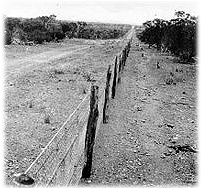
* The State Barrier Fence of Western Australia, formerly known as the No. 1 Rabbit-proof Fence is a pest-exclusion fence
constructed between 1901 and 1907 to keep rabbits and other agricultural pests out of Western Australian pastoral areas.
The Escape
THE CONDITIONS WERE so degrading and inhumane in the early years of the settlement that a staff member from that period
later pronounced that anyone living there, children or staff, were doomed1. Perhaps a huge sign warning of the perils
that lay within should have been erected at the entrance gate. However, that sign would have had no effect on the boys
and girls who were abducted2 with government approval from their traditional homelands because they were illiterate.
But Molly, Daisy and Gracie were going to be taught to read and write, this was to be their first day at school.
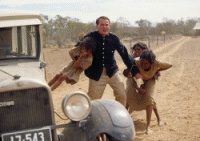 It was still dark, wet and cold on that morning in August 1931 when the girls were awakened at 5.30. The little ones
protested loudly and strongly at being forced to rise at that ungodly hour to leave their warm beds. Molly got up
reluctantly and walked out onto the verandah, peeped through the lattice3 and smiled secretly to herself. Gracie and
Daisy joined her but they didn't care for the grey, dismal day and said so in no uncertain terms4.
It was still dark, wet and cold on that morning in August 1931 when the girls were awakened at 5.30. The little ones
protested loudly and strongly at being forced to rise at that ungodly hour to leave their warm beds. Molly got up
reluctantly and walked out onto the verandah, peeped through the lattice3 and smiled secretly to herself. Gracie and
Daisy joined her but they didn't care for the grey, dismal day and said so in no uncertain terms4.
The girls waited for Martha and the others to join them, then they made their way through the slushy mud near the stone
wall of the staff quarters to the dining room. After a breakfast of weevily porridge, bread and tea, they returned to
the dormitory to wait for the school bell.
Molly had decided the night before that she and her two sisters were not staying here. She had no desire to live in this
strange place amongst people she didn't know. Anyway, she was too big to go to school, they had no right to bring her
here. She was a durn-durn, a young girl who had reached puberty, she thought, touching her small budding breasts.
These government people didn't know that she had been allocated5 a husband. But the man Burungu had passed her over6
for another Millungga sister and they had a four-year-old son. So, reasoned Molly, if she was old enough to be a
co-wife she should be working on a station somewhere. Mr Johnson, manager of Ethel Creek Station, thought so too
when he sent a telegram requesting permission to employ her and Gracie. The application was refused.
It was too early for school, so most of the smaller girls slipped back into bed. Molly, Gracie and Daisy did the same
thing but they squashed into the one bed with two girls at the head and Molly at the end.
Molly finished combing her light brown hair and lay watching the movements of the others around her. At the other end
of the bed Daisy and Gracie were whispering quietly to each other. Daisy, aged nine, had the same coloured hair and
texture as her eldest sister, while Gracie had straight, black hair that hung down to her shoulders. It was very
apparent that the three girls had inherited features from their white fathers. The only obvious Aboriginal characteristics
were their dark brown eyes and their ability to control their facial expressions, so that when they reached maturity they
would develop the look of a quiet, dignified Aboriginal woman from the Pilbara region.
The other girls were now getting ready for school, and the three watched quietly amidst all the activity. Bossing
and bullying was everywhere around them and there were cries and squeals of, "Don't, you're hurting my head," as
the tangled knots were combed out with tiny, fragile combs.
"Oh, Mummy, Daddy, Mummy, Daddy, my head," yelled a young girl, who stamped her feet and tried to pull away from her
torturer, an older, well-built girl who seemed to have adopted the girl as her baby sister. They performed this ritual
together every morning before school.
"Come on, you girls," ordered Martha Jones as she passed by their bed. "The school bell's gone. Don't be late on your
first day."
"Alright, we're coming as soon as we empty the toilet bucket," answered Molly softly.
" I'll wait for you then, " said Martha.
"No, don't wait we'll follow you, we know where the school is."
"Alright then, we'll go along. Come on, Rosie," she said as she rushed out of the door into the cold, drizzily morning.
As soon as the other girls left the dormitory, Molly beckoned her two sisters to come closer to her, then she whispered
urgently, "We're not going to school, so grab your bags. We're not staying here." Daisy and Gracie were stunned and
stood staring at her.
 "What did you say?" asked Gracie.
"l said, we're not staying here at the settlement, because we're going home to Jigalong."
Gracie and Daisy weren't sure whether they were hearing correctly or not.
"Move quickly, " Molly ordered her sisters. She wanted to be miles away before their absence was discovered. Time was
of the essence.
Her two young sisters faced each other, both looking very scared and confused. Daisy turned to Molly and said nervously,
"We're frightened, Dgudu. How are we going to find our way back home to Jigalong? It's a long way from home."
Molly leaned against the wall and said confidently, "I know it's a long way to go but it's easy. We'll find the
rabbit-proof fence and follow that all the way home."
885 words
Source: Rabbit-Proof Fence by Doris Pilkington, miramax books, New York, pp. 75-78
Annotations:
1. to be doomed - zum Scheitern verurteilt sein
2. to abduct - entführen
3. lattice - Gitter
4. in no uncertain terms - sehr klar und deutlich
5. to allocate - zuweisen, zuteilen
6. to pass s.o. over - übergehen, auslassen
7. to be stunned - fassungslos, sprachlos sein
Assignments:
1. What was the reason for the three girls being at the Moore River Settlement, who and why have they been taken there?
2. What are your impressions of the Moore River Settlement?
3. Describe the girls, including their plan to escape.
4. Imagine the differences in lifestyle between Aboriginals and the white settlers?
5. What parallels do you see between the treatment by whites of native Americans and Australian aboriginals?
|

